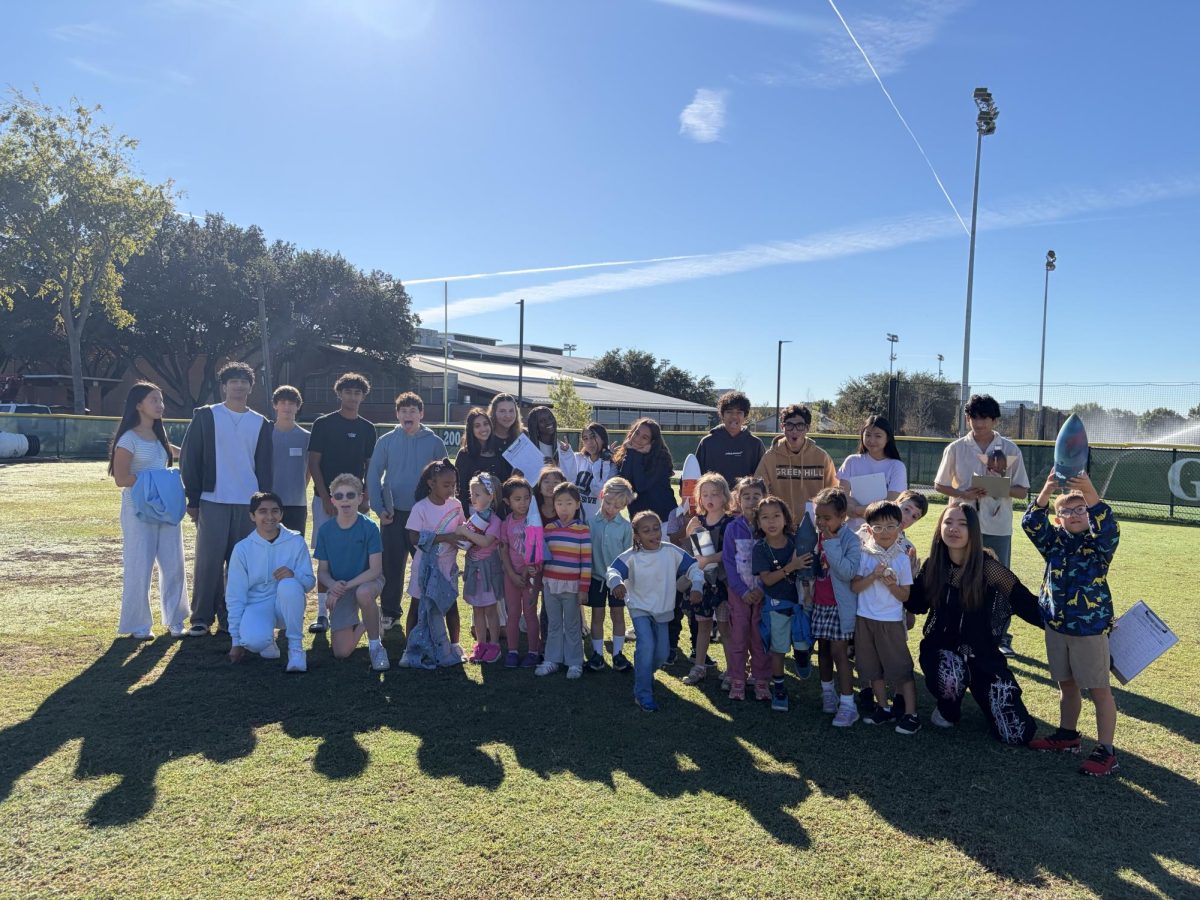
On Nov. 5-6 in the softball and baseball fields, the Honors Algebra II classes launched bottle rockets to see how the math they learn in the classroom connects to the real world.
Students prepared for the project by learning how to solve parabolic equations and applied those skills to gradually build their rockets.
“We [did] a half day of learning about parabolas and then [built] a rocket for a little bit,” Upper School math teacher Melissa Battis said.
Upper School math teacher Erik Park says the project gave students the opportunity to solidify their understanding and see what they have learned in real life.
“When students learn straight through memorization, it’s hard to see something in action and connect it back to something that they memorize,” Park said. “It’s a good way to see there’s a purpose to all this learning. It’s not just for the grade.”
While last year’s project emphasized graphical analysis and data collection, this year’s project utilizes physics equations and applications learned from previous units.
“I love when I can [bring in topics from earlier units] as a class [and] it pulls back and shows [how] all this knowledge comes together,” Battis said. “What we’re aiming at this year is how can we maintain the focus on quadratics.”
Throughout the project, students inquired about certain scientific concepts from those in higher science classes, sought support from the design lab and built off of each other’s ideas, according to Park.
“This year in particular, one student sees another person’s rocket, and they’re like, ‘I’m going to do one step better,’ even though it’s not for their overall grade,” Park said.
Sophomore Ambry Jensen and freshman AJ Ku worked together on the project and decided to create a glider shaped like a Manta ray.
Besides the necessary materials used to build the rockets including duct tape, plastic bottles and cardboard, some students applied their 3D printing and robotics skills in the design lab, according to Battis.
Beyond encouraging student discussion about math and science while providing students with the opportunity to pursue their engineering interests, the rocket project has also sparked new student ideas.