
Point-Counterpoint: Can Greenhill safely bring more students back to campus?
November 19, 2020
Greenhill administration has told faculty to prepare for the return of most students to campus in January, despite rising COVID-19 cases.
This news is being welcomed by some members of the community and criticized by others, including faculty who will be teaching in potentially riskier conditions and students who fear exposing vulnerable members to the coronavirus.
Below, two Evergreen Online writers stake out the opposing arguments in the debate underway within the Greenhill community.
Why I Support Ending Hybrid Learning
Greenhill is a community built on constant communication and group work. Because of the pandemic, we have been forced to work toward a new way of communicating and engaging with each other. However, I think every student and family that opts to be on campus should be allowed to.
As a hybrid student, during the week that I am at home it is significantly more challenging to pay attention and retain information, especially in classes that are more lecture- or lab-based. While teachers are doing their best to make both in-person and online students feel included, a student in class has the educational advantage with less distractions around them, unlike the home environment.
Right now, 25% of the Upper School student body has opted to be an online learner. If Greenhill allowed for everyone that wanted to be on campus to come, I assume around 30% of students would chose to be online. I think with a better use of a space, 70% of students would be able to reap the benefits of being on campus.
Even with 70% of student on campus, health guidelines could still easily be followed. All students should still be required to wear a mask and keep a distance of six feet at all times. Areas like Rose Hall, Black Box Theater, and the Upper School Lecture Hall can be used to accommodate bigger classes.
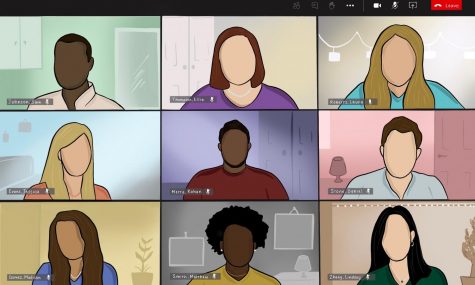
The benefits of being on campus are not only educational. As a student that has been at Greenhill for eight years and has become accustomed to the highly social learning environment within the school’s culture, the hybrid learning model makes me feel extremely isolated, and at times alone. Not seeing the other half of my grade seems extremely against one of Greenhill’s core focus on community.
Lastly, as a student-athlete, I find it frustrating that the protocols on the field and in the gym are different than those in school. I feel that if teams and coaches can practice at full capacity safely, surely students and teachers in the classroom can do the same.
Any student that is immune-compromised, has an at-risk family member or just does not feel comfortable at school potentially exposing themselves should and will have the option to go online. The rest of us should be able to return to campus.
Greenhill’s New Learning Options: Safety or Education
Recently, students, faculty and families were notified of Greenhill’s plans to shift to an in-person learning model in January with the start of the second semester.
To many of us, this came as a big surprise. It may be the timing or the decision itself, but with COVID-19 cases rising in Texas and all around the U.S. this seems to be a move that won’t end well.
I am currently a hybrid learner, but I have decided to become an online learner if we shift into a less restrictive in-person model.
In the current hybrid model, less than half of the Upper School is on campus every week. Even with this model, there are risks: during lunch, we take our masks off; in passing periods there are many people walking the hallways and during breaks, people tend to congregate.
I am concerned about an expanded in-person model because those risks would be multiplied.
Meeting in classrooms with social distancing of six feet or having lunch apart from one another in a single advisory room no longer becomes feasible. Regardless of proposed changes to alleviate these concerns (classroom in tents, using Greenhill Office Towers, having more outdoor spaces) the reality is there will simply be more people on campus.
No matter what can be done to keep people distanced in classes, the major concern is out of the classroom, when those small congregations become large ones and when the outdoor spaces become uninhabitable (rain, snow, etc.).
It is simply not worth the risk.
Even if there was a way to alleviate these risks, is the new reality really the version of school that families want? Having larger classrooms in Rose Hall and the Lecture Hall? If students complain about not being able to pay attention in an online setting, this seems even more likely in large classes in a lecture setting.
An administration survey sent out to families even asked if they were willing to sacrifice the social distancing rules of six feet; its important to contextualize what this would mean for learning. The likelihood of being exposed to COVID-19 and subsequently be sent home because of contact tracing increases exponentially. If people are really so insistent on going back to school, the likelihood of getting sent home is much larger in this new reality.
My father has amyotrophic lateral sclerosis (ALS), also known as Lou Gehrig’s disease, the progressive degeneration of nerve cells that control muscle movements. My father’s disease marks him as a high-risk individual under coronavirus protocols. So, too, is my grandmother, who lives with us.
If Greenhill pushes forward with plans to reopen campus to all students, I would have no other choice but to become an online learner—all because people are pushing for a model that makes me decide between my education and my safety.
I am not alone in these circumstances. Many students and faculty face similar risks. However, unline students, faculty don’t have much of a choice.
We are currently facing a global pandemic ravaging the world. At a time with rising cases, with people making the decision to go on numerous vacations and others attending large parties, it is not the time to expand in-person classes.
Nationally, schools are closing down.
I understand that it’s difficult to learn in an online environment, but the insistence on bringing things as close to normal as possible is ignorant of the reality that we are facing.
So, I urge Greenhill administration and families to rethink this decision. It is not the time nor the place to go fully in person. There is simply too much at stake.